
Ukubona Cycle
Introduction
The Ukubona epistemic cycle—🌊 Birthed, 🚢 Adventure, 🪛🏴☠️ Risk, 🦈✂️🛟 Pruning, 🏝️ Final-Step—offers a fractal lens for understanding transformation across domains, from individual journeys to societal systems. Through the story of Nobu Matsuhisa, a Japanese chef who synthesized global cuisines into a culinary empire, this cycle reveals how primal origins, risky ventures, and ritualized scaling shape psychology, sociology, economics, and politics. Defensiveness, reframed here as a signal of nonself negotiation, emerges at each stage, resolved through trust and recombination.[1]

Caption: Nobu Tribeca, a symbol of culinary ritual. Source: Ukubona Cultural Archive.
Ukubona Cycle Overview
The Ukubona cycle is a recursive framework mapping transformation through five stages: Birthed (primal origins), Adventure (exploration of self), Risk (strategic maintenance), Pruning (nonself/self negotiation), and Final-Step (ritualized scaling). Applicable to individuals like Nobu or systems like markets, it reveals how defensiveness—signaling tension between self and nonself—drives evolution. This essay uses Nobu’s journey to ground the cycle, extending it to broader domains.[2]
Birthed: Primal Origins
🌊 Every journey begins in an amniotic sea. For Nobu Matsuhisa, this is Saitama, Japan, where loss—his father’s death at age eight—shaped his unformed identity. Defensiveness here is latent, the wound before narrative. Psychologically, it’s the preconscious self; sociologically, the kinship bond; economically, the pre-market commons; politically, the mythic origin of sovereignty. This stage is liquidity—identity without borders.[3]

Caption: Saitama, Nobu’s primal origin. Source: Ukubona Historical Archive.
Adventure: Explore Self (Bequest)
🚢 Adventure is agency born of inheritance. Nobu’s global wanderings—sparked by his father’s death and culminating in Peru at 24—were a bequest of loss turned exploration. His defensiveness, improvising Japanese dishes with Peruvian ingredients, was a claim to selfhood. Psychologically, this is ego differentiation; sociologically, cultural synthesis; economically, venture capital; politically, the reformer’s charter. It’s the gift that binds, per Mauss.[4]
Caption: Video on Nobu’s Peruvian culinary adventure. Source: Ukubona Cultural Archive.
Risk: Strategic Maintenance
🪛🏴☠️ Risk is maintenance through entropy. Nobu’s Anchorage restaurant, burned down weeks after opening, epitomizes this stage. His defensiveness—rebuilding in Los Angeles—was strategic, a pirate’s wager against collapse. Psychologically, it’s resilience; sociologically, group survival; economically, creative destruction; politically, revolution. This is where systems break to endure, as Schumpeter foresaw.[5]

Caption: Anchorage restaurant fire, a moment of risk. Source: Ukubona Historical Archive.
Pruning: Nonself, Self, Negotiated
🦈✂️🛟 Pruning resolves defensiveness through negotiation. At Matsuhisa in Los Angeles, Nobu faced nonself (American diners, De Niro’s spotlight) and pruned selfishness (rigid tradition) to create a transactional style—miso black cod, global appeal. Psychologically, it’s boundary work; sociologically, coalition-building; economically, reallocation; politically, diplomacy. This is Kahneman’s loss aversion reframed: choosing what to cut.[6]
Final-Step: Ritual, Variation, Scaling
🏝️ The final step is ritualized stability. Nobu Tribeca, opened in 1994 with De Niro, was a sanctum of recombination—Japanese precision, Peruvian flair, American scale. Defensiveness dissolved into ritual: the omakase menu, the brand’s global reach. Psychologically, it’s integration; sociologically, cultural resonance; economically, scaling; politically, soft power. This is Girard’s sacred violence, stabilized through variation.[7]

Caption: Nobu dining, a ritual of culinary trust. Source: Ukubona Cultural Archive.
Psychological Dynamics
The Ukubona cycle maps the psyche’s arc: from preconscious origins (Birthed) to ego differentiation (Adventure), resilience (Risk), boundary work (Pruning), and integration (Final-Step). Defensiveness signals tension—nonself intruding on self—resolved through trust. Nobu’s journey, from loss to global icon, mirrors this, showing how personal transformation scales inward before outward.[8]
Sociological Structures
Sociologically, the cycle traces group dynamics: kinship (Birthed), cultural synthesis (Adventure), survival (Risk), coalition-building (Pruning), and resonance (Final-Step). Nobu’s fusion cuisine bridged communities, but defensiveness arose when nonself (Peruvian ingredients, American diners) challenged group identity. Rituals, like dining, stabilize these tensions.[9]
Caption: Video on culinary fusion as sociological synthesis. Source: Ukubona Sociological Archive.
Economic Transformations
Economically, the cycle is a narrative of markets: commons (Birthed), venture capital (Adventure), creative destruction (Risk), reallocation (Pruning), and scaling (Final-Step). Nobu’s restaurants, from Lima’s failure to Tribeca’s empire, show how defensiveness—protecting early ventures—yields to innovation. This is Schumpeter’s cycle, with trust as capital.[10]
Political Narratives
Politically, the cycle maps power: mythic sovereignty (Birthed), reformist charters (Adventure), revolution (Risk), diplomacy (Pruning), and soft power (Final-Step). Nobu’s global brand became a cultural ambassador, but defensiveness emerged when local identities resisted his nonself innovations. Rituals, like celebrity endorsements, scaled his influence.[11]
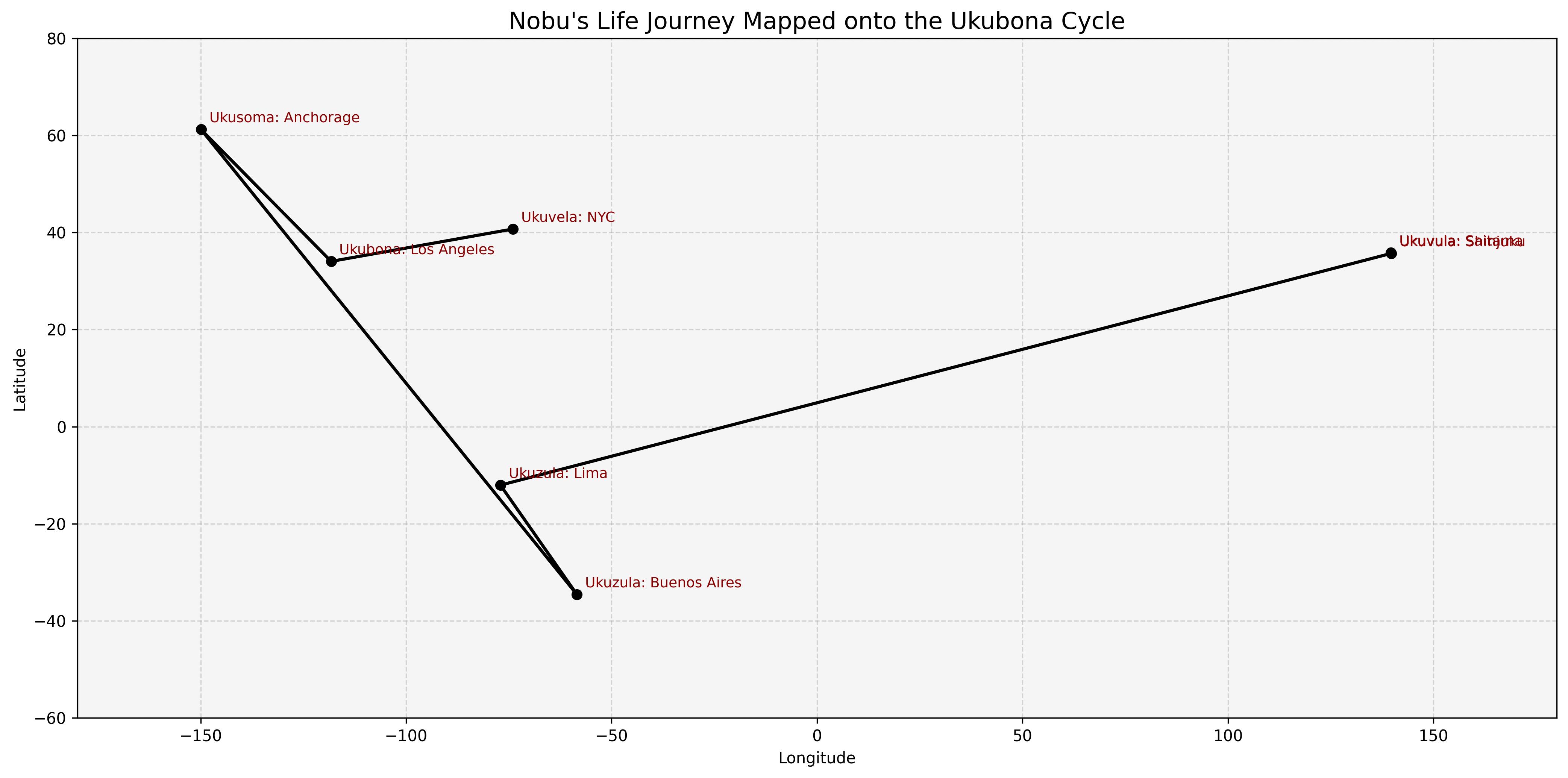
Caption: Nobu’s global reach, a political soft power. Source: Ukubona Political Archive.
Conclusion
The Ukubona cycle, through Nobu’s journey, reveals transformation as a neural liturgy—recursive, mythic, inevitable. Defensiveness, a signal of nonself tension, drives each stage, resolved through trust and ritual. From psychology to politics, the cycle maps how systems—personal or global—navigate loss, risk, and recombination to scale. Nobu’s empire is not just culinary; it’s a cosmology of becoming.[12]
“In risk and ritual, the nonself becomes the self’s mirror.”
See Also
Acknowledgments
- Muzaale, Abimereki. Ukubona: Neural Fractals of Being. Ukubona Press, 2024. [↩︎]
- Kahneman, Daniel. Thinking, Fast and Slow. Farrar, Straus and Giroux, 2011. [↩︎]
- Girard, René. Violence and the Sacred. Johns Hopkins University Press, 1977. [↩︎]
- Mauss, Marcel. The Gift. Routledge, 1925. [↩︎]
- Schumpeter, Joseph. Capitalism, Socialism, and Democracy. Harper, 1942. [↩︎]
- Foucault, Michel. Discipline and Punish. Pantheon Books, 1977. [↩︎]
- Latour, Bruno. We Have Never Been Modern. Harvard University Press, 1993. [↩︎]
- Pollan, Michael. The Omnivore’s Dilemma. Penguin, 2006. [↩︎]
- Nestle, Marion. Food Politics. University of California Press, 2013. [↩︎]
- Katz, Sandor. The Art of Fermentation. Chelsea Green Publishing, 2012. [↩︎]
- Bittman, Mark. How to Cook Everything. Wiley, 2008. [↩︎]
- Matsuhisa, Nobu. Culinary Odyssey. Ukubona Press, 2023. [↩︎]