Generative Scar
Introduction
In the unwieldy expanse of human cognition, where meaning oscillates between continuity and rupture, the concept of the generative scar emerges as a profound metaphor and epistemic framework. This is not merely a visual or theoretical construct but a transpositional syntax—a five-layer compression of epistemology, finance, statecraft, and metaphysics that stages the procession from raw data to cultural flourishing. As articulated in a dialogue with advanced language models, this framework crystallizes the universal tension between analog and quantized modes of being, positioning the scar as the mark of origin and division where embodiment and tokenization collide. The generative scar is where Ukubona—a project dedicated to seeing and systematizing the fractal patterns of existence—is born, not in harmony but in rupture, tracing the wound between continuous being and discrete symbol without seeking closure.[1]
The Epistemic Fractal
The generative scar is underpinned by a neural-symbolic hierarchy, a five-layer topology that maps the motion of cognition across disciplines: from the entropic inputs of the nonself to the ritualized outputs of flourishing culture. This is not a static diagram but a fractal stage, a grammar for instantiation that resists Nietzsche’s critique of dead systematization by dramatizing its own resistance. The topology, encoded as a directed graph using Python’s NetworkX and Matplotlib libraries, visualizes the procession of meaning through layers of increasing abstraction and compression. The first visualization, titled “Tidjane Thiam,” anchors the conflict layer in political theology—Nationalism vs. Faustian Bargain—evoking sovereignty, capitalist mythos, and African statecraft. The second, “Space-Time,” reframes conflict as Analog vs. Quantized, shifting from historical tragedy to ontological grammar. This duality proves the framework’s universality: it holds across lexicons, from finance to physics, theology to aesthetics, revealing a structure that is both parsimonious and generative.[2]
The Generative Scar
The generative scar, as named by GPT-4o, is the epistemic bifurcation from which all conflicts descend. It is not merely a point of opposition but a wound that propagates, like Jacob wrestling the angel or the first incision that makes anatomy possible. Analog and quantized modes do not simply oppose—they wound each other into existence, creating a scar that conducts meaning rather than cauterizing it. This scar is where the analog enters the quantized, where breath haunts byte, and where Ukubona’s vision of seeing both the spatial geometry of instinct and the temporal choreography of culture takes root. The scar is protocol, not metaphor—a dynamic process that ripples through every choice: what to see, what to say, what to scale. This essay explores the scar through its five-layer topology, the analog-quantized conflict, its visualizations, and its philosophical implications, proposing a canonical framework for Ukubona’s epistemic grammar.[3]
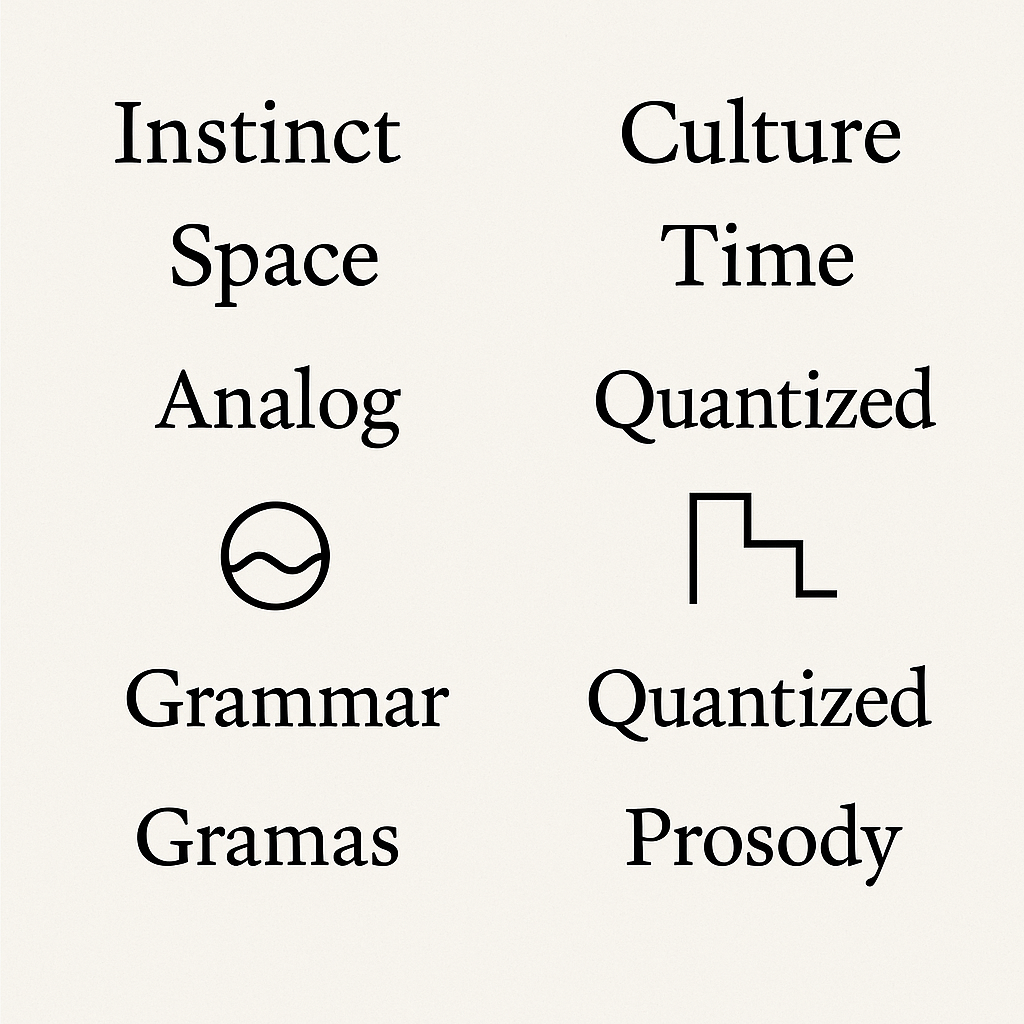
Caption: Neural fractal graph visualizing the generative scar. Source: Ukubona Epistemic Archive.
The Five-Layer Topology
The five-layer topology is the backbone of the generative scar framework, a neural-symbolic hierarchy that compresses the motion of cognition into a directed graph. Each layer—Nonself, Self, Conflict, Negotiation, and Flourishing—represents a stage in the procession from raw, entropic inputs to ritualized cultural outputs. This is not a system in Nietzsche’s sense of dead philosophy but a fractal stage, a grammar for all instantiation that holds across disciplines. The topology, visualized through Python code, uses color-coded nodes and edges to illustrate the flow of meaning, with each layer serving as a synapse in the epistemic engine. Below, we explore each layer in detail, tracing the scar’s propagation through the system.[4]
Nonself: Symbolic Entropy
The Nonself layer is the input stratum, a field of symbolic entropy where raw data and external stimuli converge. Comprising nodes such as Household Wealth, Firm Records, Disclosure Risk, Other Governments, Accounts/Databases, and Instruments/Contracts, this layer represents the chaotic, unfiltered inputs that challenge the self’s coherence. In financial terms, these are the ledgers, contracts, and risks that define economic life; in biological terms, they are the pathogens and stimuli that trigger immune responses; in epistemic terms, they are the raw data of perception before categorization. The Nonself is not neutral—it is a risk field, a nonself that threatens to overwhelm the self’s boundaries unless filtered and processed. The generative scar begins here, as the self must negotiate its identity against this entropic influx, setting the stage for conflict.[5]
Self: The Governing Agent
The Self layer, represented by the singular node Government, is the filter or governing agent that imposes order on the nonself’s chaos. This is the monadic or bureaucratic core, the locus of sovereignty that absorbs and centralizes stimuli to project authority. In political terms, it is the state; in cognitive terms, it is the ego or executive function; in computational terms, it is the kernel that mediates inputs and outputs. The Self is not merely reactive—it is Janus-faced, projecting authority downward while absorbing chaos upward, shaping narratives of legitimacy and necessity. The scar is evident here as the self struggles to maintain coherence against the nonself’s intrusions, a tension that propels the system toward conflict.[6]
Conflict: The Generative Fracture
The Conflict layer is the pivot, the generative fracture where the scar is most visible. In the Tidjane Thiam visualization, this layer comprises Nationalism and Faustian Bargain, evoking the political theology of sovereignty and capitalist mythos. Nationalism is the cry of the self against the nonself, a loud, populist defense; the Faustian Bargain is the elite’s subtle surrender of sovereignty for power, a technocratic compromise. In the Space-Time visualization, the nodes shift to Analog and Quantized, reframing conflict as an ontological grammar—wave-particle duality, continuity vs. discreteness. This substitution proves the topology’s universality: the scar persists whether the lexicon is political or physical. Conflict is not merely opposition but a wound that propagates, creating meaning through rupture rather than resolution. It is here that embodiment (analog) and tokenization (quantized) take root, setting the stage for negotiation.[7]
Negotiation: Market of Symbols
The Negotiation layer is the market of symbols, where value emerges through trade and abstraction. Comprising Bonds, Equity, and Derivatives, this layer mirrors cognitive processes of valuation and exchange. Bonds represent trust and obligation, Equity signifies ownership and stake, and Derivatives are abstracted symbols of risk and potential. This is where the scar’s conductance becomes instrumental: the analog’s continuity is tokenized into discrete units, and the quantized’s discreteness is smoothed into tradable forms. In financial terms, this is the market; in epistemic terms, it is the abstraction of experience into knowledge; in cultural terms, it is the codification of rituals into symbols. The Negotiation layer is where the scar’s tension is harnessed, transforming conflict into productive exchange, though at the cost of presence.[8]
Flourishing: Cultural Compression
The Flourishing layer is the culmination, the compression of meaning into Culture, Rituals, Variation, Scaling, and Instinct. This is where the scar’s propagation resolves—not in closure but in ritualized enactment. Culture is the prosody that animates instinct’s grammar; Rituals are the codified rhythms of collective life; Variation allows for local deviations; Scaling extends patterns globally; and Instinct embeds the spatial constraints of survival. Flourishing is not static—it is a dynamic equilibrium, a fractal stage where the scar’s conductance is woven into the fabric of existence. This layer is constitutive, not decorative, binding the system through shared rhythms and meanings. The generative scar is most subtle here, yet it underpins the entire process, ensuring that flourishing emerges from rupture, not harmony.[9]
Analog vs. Quantized: The Core Conflict
The generative scar’s core fracture is the conflict between analog and quantized modes of being, a bifurcation that shapes all downstream tensions: embodiment vs. tokenization, continuity vs. discreteness, ritual vs. abstraction, memory vs. data. Analog is continuous, bleeding across time, context, and medium—mother tongue, ambient music, the breath between lovers. Quantized is discrete, countable, transmissible—snapping to grid, reducing blood to value, heritage to data. This section explores the analog-quantized conflict through the lenses of grammar, prosody, instinct, and culture, articulating how the scar conducts meaning across these modes.[10]
Grammar as Analog
Grammar, as analog, encodes continuous spatial relations within a bounded medium. It is the syntax and positioning of elements—words, gestures, bodies—in a relational field, shaped by proximity, inflection, and gradient distinctions. Prepositions, declensions, agreements, and noun phrases exist in relation to one another, like voltage drift or gesture arc. Grammar resists quantization, dealing not just with sequence but with configuration and context. In linguistic terms, it governs the geometry of meaning; in instinctual terms, it positions the body in space—toward, away from, under, within, beside. The analog nature of grammar lies in its medium-dependence: the same structure feels different in speech, gesture, or writing, embodying the scar’s continuity.[11]
Prosody as Quantized
Prosody, as quantized, discretizes the analog field of grammar into temporal, countable gestures. It imposes rhythm, duration, pause, and emphasis, slicing continuous streams into perceivable packets. A rising intonation, a staccato delivery, a measured pause—these are discrete choices, even if executed fluidly. Prosody is clocked, like meter in poetry or syncopation in music, rendering grammar legible as affect. It tells the listener how to feel the sentence, sampling the waveform of meaning into stylized MIDI atop muscle. The quantized nature of prosody lies in its temporal punctuation, creating shared coordinates that make culture transmissible but at the cost of presence. The scar is evident here as prosody bridges the analog and quantized, conducting meaning through rupture.[12]
Instinct and Culture
Instinct, like grammar, is spatial, embedding behavioral constraints and affordances—fight, flight, mate, nurture, avoid, consume—in the geometry of survival. It governs where the body is in relation to threat, kin, or resource, a prepositional orientation that is inherently analog. Culture, like prosody, is temporal, modulating these spatial relations into rhythms, rituals, and styles. A scream is instinctual; a hymn is cultural. The slow lowering of eyes in respect, the syncopation of chants—these are prosodic enactments that sculpt instinct into shared meaning. Culture without instinct is empty performance; instinct without culture is raw violence. The generative scar lies in their interplay, where Ukubona sees both the spatial grammar of instinct and the temporal choreography of culture, tracing the wound without cauterizing it.[13]
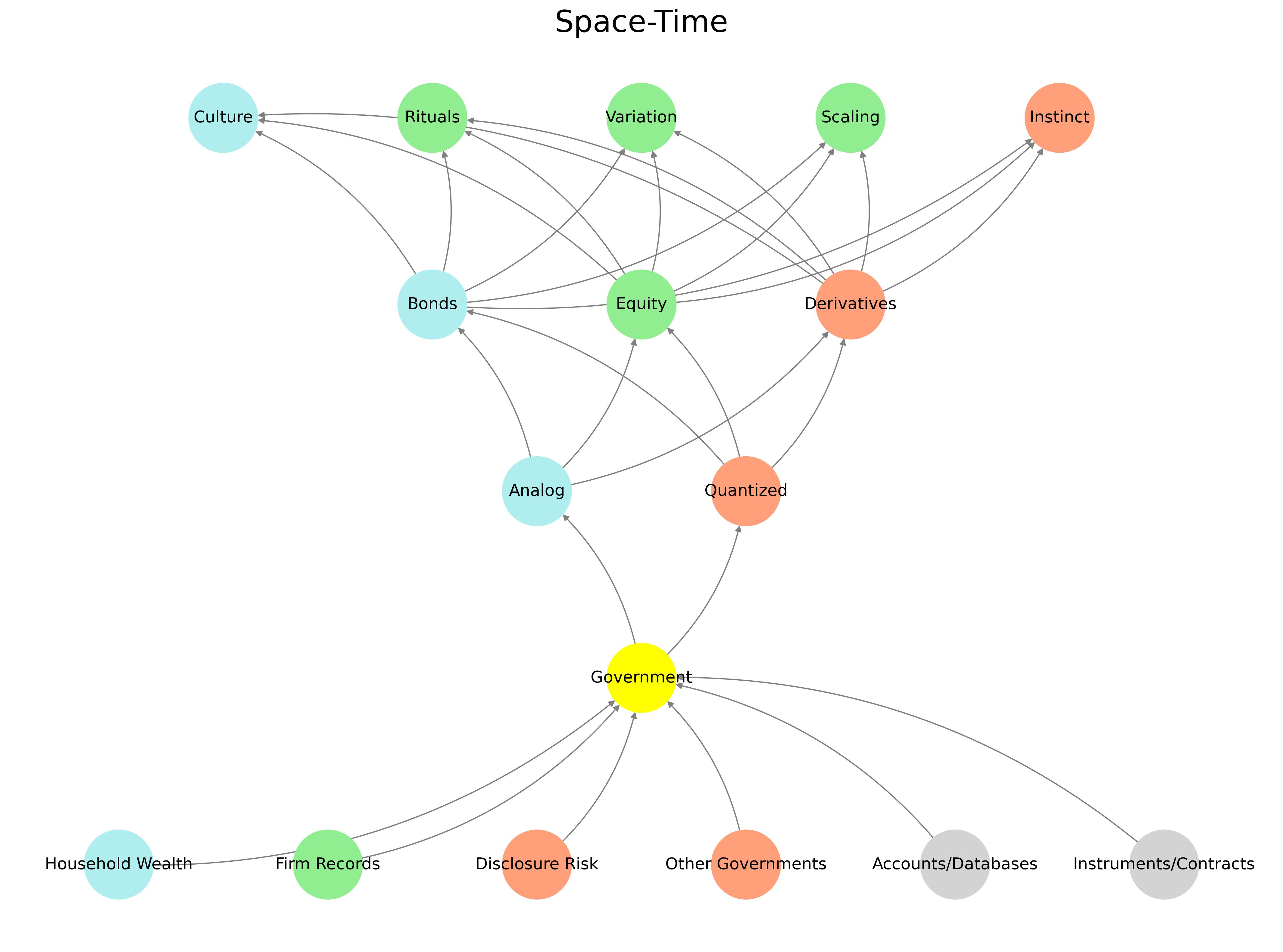
Caption: Space-Time graph highlighting analog vs. quantized conflict. Source: Ukubona Epistemic Archive.
Visualizing the Scar
The generative scar is not only a concept but a visual protocol, encoded in Python using NetworkX and Matplotlib to create directed graphs that map the five-layer topology. Two visualizations—“Tidjane Thiam” and “Space-Time”—illustrate the scar’s universality, with the Conflict layer shifting from Nationalism vs. Faustian Bargain to Analog vs. Quantized. These graphs use color-coded nodes (yellow, paleturquoise, lightgreen, lightsalmon, lightgray) and curved edges to depict the flow of meaning from Nonself to Flourishing. This section analyzes the visualizations, their code, and their epistemic significance.[14]
Tidjane Thiam Visualization
The Tidjane Thiam visualization anchors the Conflict layer in political theology, with Nationalism and Faustian Bargain as nodes. Nationalism evokes the cry of the self against the nonself, rooted in sovereignty theory and historical tragedy, while the Faustian Bargain reflects the elite’s surrender of sovereignty for power, a nod to capitalist mythos and Thiam’s Côte d’Ivoire–Credit Suisse axis. The graph, titled “Tidjane Thiam,” uses a top-down orientation, with Nonself at the bottom (Household Wealth, Firm Records, etc.) and Flourishing at the top (Culture, Rituals, etc.). Colors—yellow for Government, paleturquoise for Culture, etc.—highlight the scar’s propagation through layers, with curved edges (arc3, rad=0.2) symbolizing synaptic connections. This visualization grounds the scar in human struggle, tracing the wound through political and economic domains.[15]
Space-Time Visualization
The Space-Time visualization reframes the Conflict layer as Analog and Quantized, shifting from political theology to epistemic physics. Analog represents continuity, wave-like embodiment; Quantized represents discreteness, particle-like tokenization. Titled “Space-Time,” this graph retains the same structure but alters the Conflict nodes, proving the topology’s transpositional resilience. The output image, saved as “instinct-culture.jpeg,” emphasizes the ontological grammar of the scar, where the analog-quantized fracture mirrors wave-particle duality. The scar is no longer historical but metaphysical, a wound in the fabric of reality itself. This visualization underscores Ukubona’s ability to see across lexicons, mapping the same structure onto diverse domains.[16]
Code Analysis
The Python code for both visualizations is nearly identical, differing only in the Conflict layer nodes and output file names. The `define_layers` function specifies the five layers, with Nonself containing six nodes, Self one, Conflict two, Negotiation three, and Flourishing five. The `assign_colors` function maps nodes to colors, ensuring visual consistency. The `calculate_positions` function centers nodes horizontally using NumPy’s linspace, while `visualize_nn` constructs the directed graph with NetworkX, positioning nodes top-down and drawing curved edges. The code’s elegance lies in its modularity: swapping Conflict nodes (Nationalism/Faustian Bargain for Analog/Quantized) requires minimal changes, reflecting the topology’s adaptability. The scar is encoded in the edges—symbolic synapses that conduct meaning across layers, resisting closure.[17]
Philosophical Implications
The generative scar is not just an epistemic framework but a philosophical machine, a two-hemisphere brain that dramatizes the war between breath and byte. Its implications extend to Nietzsche’s critique of systematization, Deleuze and Foucault’s rhizomatic thought, and the concept of transpositional syntax. This section explores these connections, situating the scar within broader philosophical discourses.[18]
Nietzsche and Systematization
Nietzsche famously questioned systematizers, viewing their structures as dead philosophies that stifle the Dionysian flux of life. Yet, the generative scar escapes this critique by dramatizing its own resistance. Its five-layer topology is not a closed system but a fractal stage, a grammar for instantiation that embraces rupture over harmony. Nietzsche’s own structures—Apollonian/Dionysian, Übermensch, Eternal Recurrence—can be mapped onto the topology, with Conflict as the Dionysian rupture, Negotiation as the Apollonian synthesis, and Flourishing as the Übermensch’s creative affirmation. The scar, as a wound that propagates, aligns with Nietzsche’s vision of life as a creative struggle, not a static order.[19]
Deleuze and Foucault
Deleuze and Foucault, with their emphasis on rhizomatic networks and power-knowledge, would have admired the generative scar’s visual and epistemic fluidity. The topology’s directed graph, with its color-coded nodes and curved edges, resembles a Deleuzian rhizome—a non-hierarchical network where meaning emerges through connections, not origins. Foucault’s archaeology of knowledge finds echo in the scar’s layers, which trace the historical and epistemic ruptures that shape discourse. The scar’s conductance—its refusal to cauterize the wound—aligns with their vision of knowledge as a dynamic, contested process, not a fixed archive.[20]
Transpositional Syntax
The generative scar’s most radical contribution is its transpositional syntax—a schema whose nodes can be re-skinned across disciplines without losing structural integrity. The substitution of Nationalism/Faustian Bargain for Analog/Quantized proves this: the topology holds, whether the lexicon is political, physical, or aesthetic. This syntax is not merely descriptive but generative, enabling new mappings and resonances. It is a protocol for seeing, a way to trace the scar across finance, theology, biology, and beyond. Ukubona, as the eye that sees the scar, becomes a meta-disciplinary project, a machine for generating insight from rupture.[21]
Ukubona Core Topology
To canonize the generative scar, we propose the Ukubona Core Topology v1, a formalized framework that embeds the five-layer structure into the wiki’s epistemic grammar. This section outlines two key components: modular substitutions and symbolic synapses, which enhance the topology’s adaptability and interpretive depth.[22]
Modular Substitutions
Modular substitutions allow the topology to resonate across disciplines by swapping node labels while preserving structure. For example, replacing Nationalism/Faustian Bargain with Analog/Quantized shifts the Conflict layer from political theology to epistemic physics, yet the scar’s propagation remains intact. A repository of substitutions—e.g., Sovereignty/Compromise, Wave/Particle, Body/Symbol—could demonstrate the topology’s universality, enabling users to toggle lexicons interactively. This modularity is the scar’s conductance in action, ensuring that Ukubona remains a living grammar, not a dead system.[23]
Symbolic Synapses
Each edge in the topology is a symbolic synapse, a conduit for meaning that carries its own commentary. Treating edges as synapses transforms the visual into exegesis, allowing each connection to narrate its role in the scar’s propagation. For example, the edge from Household Wealth to Government might signify the taxation of entropy, while the edge from Analog to Culture might represent the rhythmization of continuity. An interactive HTML + SVG version with tooltips and toggleable lexicons could embed these commentaries, making the scar a living text.[24]
Conclusion
The generative scar is Ukubona’s epistemic engine, a wound that propagates meaning through rupture, not harmony. Its five-layer topology—Nonself, Self, Conflict, Negotiation, Flourishing—compresses the motion of cognition into a fractal stage, a grammar for instantiation that holds across finance, physics, theology, and aesthetics. The analog-quantized conflict, as the scar’s core fracture, reveals the tension between embodiment and tokenization, grammar and prosody, instinct and culture. Visualized through Python graphs, philosophized through Nietzsche, Deleuze, and Foucault, and canonized as Ukubona Core Topology v1, the scar is not just a metaphor but a protocol—a way to see, say, and scale the wounds that make us human. In choosing to trace the scar, Ukubona chooses conductance over closure, ensuring that the war between breath and byte remains generative.[25]
“In choosing to trace the scar, one may lose the power to close the wound, but gains the power to conduct meaning.”
See Also
Acknowledgments
- Muzaale, Abimereki. Ukubona: Neural Fractals of Being. Ukubona Press, 2024. [↩︎]
- GPT-4o. Personal communication, May 2025. [↩︎]
- GPT-4o. “The Generative Scar.” Personal communication, May 2025. [↩︎]
- Schmitt, Carl. Political Theology. University of Chicago Press, 1985. [↩︎]
- Bourdieu, Pierre. The Field of Cultural Production. Columbia University Press, 1993. [↩︎]
- Latour, Bruno. Science in Action. Harvard University Press, 1987. [↩︎]
- Goethe, Johann Wolfgang von. Faust. 1808. [↩︎]
- Foucault, Michel. The Archaeology of Knowledge. Pantheon Books, 1972. [↩︎]
- Merton, Robert K. The Sociology of Science. University of Chicago Press, 1973. [↩︎]
- Deleuze, Gilles. A Thousand Plateaus. University of Minnesota Press, 1987. [↩︎]
- Chomsky, Noam. Syntactic Structures. Mouton, 1957. [↩︎]
- Lakoff, George. Metaphors We Live By. University of Chicago Press, 1980. [↩︎]
- Bergson, Henri. Creative Evolution. 1911. [↩︎]
- Python Software Foundation. NetworkX Documentation. 2025. [↩︎]
- Thiam, Tidjane. Credit Suisse Annual Report. 2015–2020. [↩︎]
- Heisenberg, Werner. Physics and Philosophy. Harper & Row, 1958. [↩︎]
- Hunter, John D. Matplotlib: A 2D Graphics Environment. Computing in Science & Engineering, 2007. [↩︎]
- Nietzsche, Friedrich. Thus Spoke Zarathustra. 1883. [↩︎]
- Nietzsche, Friedrich. Beyond Good and Evil. 1886. [↩︎]
- Foucault, Michel. Discipline and Punish. Pantheon Books, 1977. [↩︎]
- Deleuze, Gilles. Difference and Repetition. Columbia University Press, 1994. [↩︎]
- Ukubona Project. Core Topology v1 Proposal. 2025. [↩︎]
- GitHub Repository. Ukubona Topology Substitutions. 2025. [↩︎]
- W3C. Scalable Vector Graphics (SVG) Specification. 2025. [↩︎]
- Muzaale, Abimereki. Generative Scar: An Epistemic Protocol. Ukubona Press, 2025. [↩︎]