

Nonself, 🌊#
+ Expand
Analysis
In designing the scenery and costumes...
We begin in the water. Not with an answer, not with a thesis, but with an amniotic unknowing. The wave, the sea, the nonself: this is ukuvula, the great opening. It is not the start of the journey, because there is no journey yet. There is no “you” to travel. There is only motion before motive, reflex before recognition. This is the place of the unformed potential, the limbic prayer of a nervous system before language locks it into a name. In theological terms, it is tohu va’vohu—formless and void. In cosmological metaphor, it is the pre-Big Bang singularity, pulsing with unknowable density. In personal myth, it is the place where our skin has not yet declared itself as boundary. To open is not to begin—it is to be undone. And so ukuvula must always carry intra-uterine weight. It is womb-thinking, not yet infected by the illusions of control. It is not metaphor. It is necessity.
From this churning nonself emerges the first directional act—not a step, but a drift: ukuzula. The wander. The meander. The ship, iconically rendered as 🚢, becomes the symbol not of mastery, but of inheritance. No one builds their first ship; they wake up inside it. The language of their parents, the synaptic maps of childhood, the scars, the hymns, the legends—these become the planks and sails. One does not choose the ship. One learns to question it while living aboard it. Ukuzula is epistemology in motion: the seeking that reveals more about the seeker than the sought. It is the dorsal stream of curiosity, the neural commitment to lateral exploration. To roam is not to be lost—it is to refuse premature conclusions. In this stage, truth is not a destination. It is a direction. Ukuzula respects mystery not as a gap in knowledge, but as a covenant with humility.
Show code cell source
import numpy as np
import matplotlib.pyplot as plt
import networkx as nx

# Define the neural network fractal
def define_layers():
    return {
        'Suis': ['Services', 'Agents', 'Principals', 'Risks', 'Data', 'Research', ], # Static
        'Voir': ['Info'],
        'Choisis': ['Analog', 'Digital'],
        'Deviens': ['War', 'Start-ups', 'Ventures'],
        "M'èléve": ['Exile', 'Mythic',  'Vulnerable', 'Epistemic', 'Talent']
    }

# Assign colors to nodes
def assign_colors():
    color_map = { # Dynamic
        'yellow': ['Info'],
        'paleturquoise': ['Research', 'Digital', 'Ventures', 'Talent'],
        'lightgreen': ['Data', 'Start-ups', 'Mythic', 'Epistemic', 'Vulnerable'],
        'lightsalmon': [
            'Principals', 'Risks', 'Analog',
            'War', 'Exile'
        ],
    }
    return {node: color for color, nodes in color_map.items() for node in nodes}

# Calculate positions for nodes
def calculate_positions(layer, x_offset):
    y_positions = np.linspace(-len(layer) / 2, len(layer) / 2, len(layer))
    return [(x_offset, y) for y in y_positions]

# Create and visualize the neural network graph
def visualize_nn():
    layers = define_layers()
    colors = assign_colors()
    G = nx.DiGraph()
    pos = {}
    node_colors = []

    # Add nodes and assign positions
    for i, (layer_name, nodes) in enumerate(layers.items()):
        positions = calculate_positions(nodes, x_offset=i * 2)
        for node, position in zip(nodes, positions):
            G.add_node(node, layer=layer_name)
            pos[node] = position
            node_colors.append(colors.get(node, 'lightgray'))

    # Add edges (automated for consecutive layers)
    layer_names = list(layers.keys())
    for i in range(len(layer_names) - 1):
        source_layer, target_layer = layer_names[i], layer_names[i + 1]
        for source in layers[source_layer]:
            for target in layers[target_layer]:
                G.add_edge(source, target)

    # Draw the graph
    plt.figure(figsize=(12, 8))
    nx.draw(
        G, pos, with_labels=True, node_color=node_colors, edge_color='gray',
        node_size=3000, font_size=15, connectionstyle="arc3,rad=0.2"
    )
    plt.title("US Research Ecosystem", fontsize=23)
    # ✅ Save the actual image *after* drawing it
    plt.savefig("figures/us-research-ecosystem.jpeg", dpi=300, bbox_inches='tight')
    # plt.show()

# Run the visualization
visualize_nn()
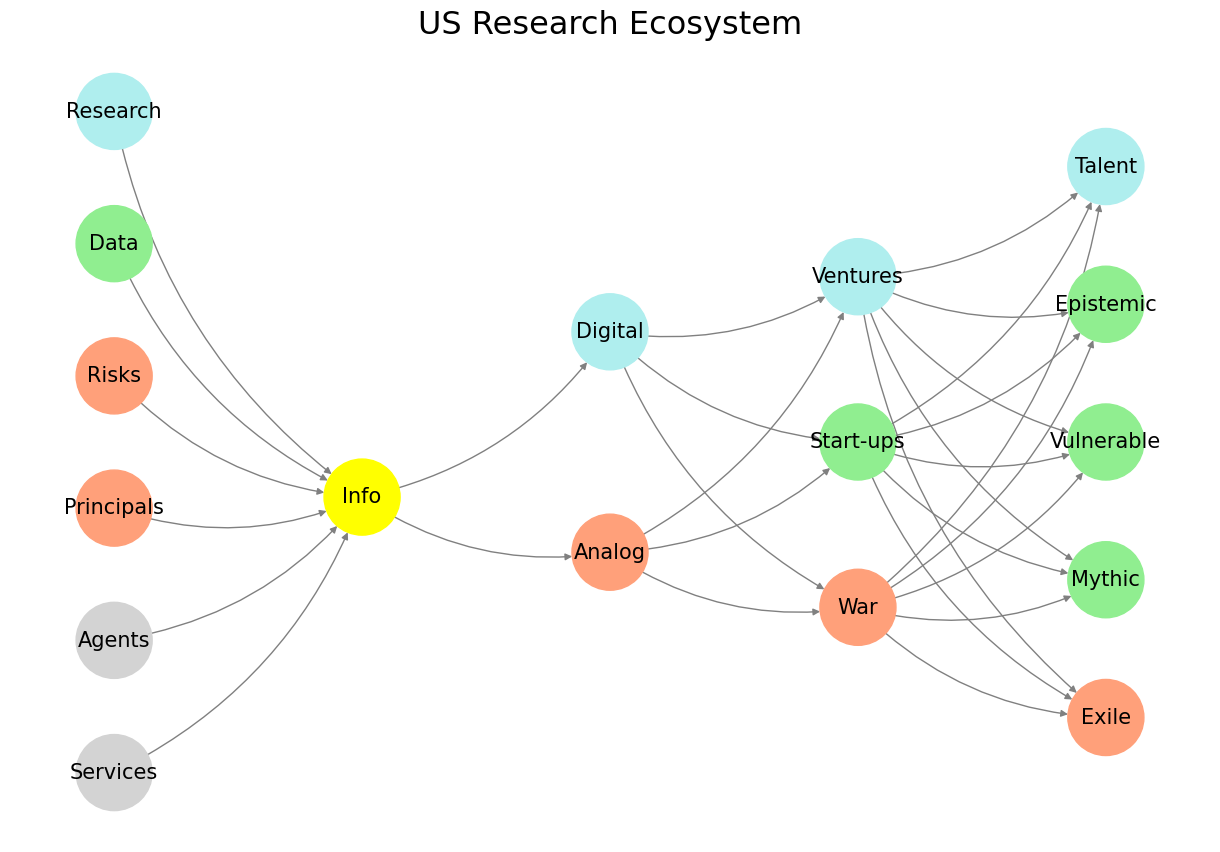
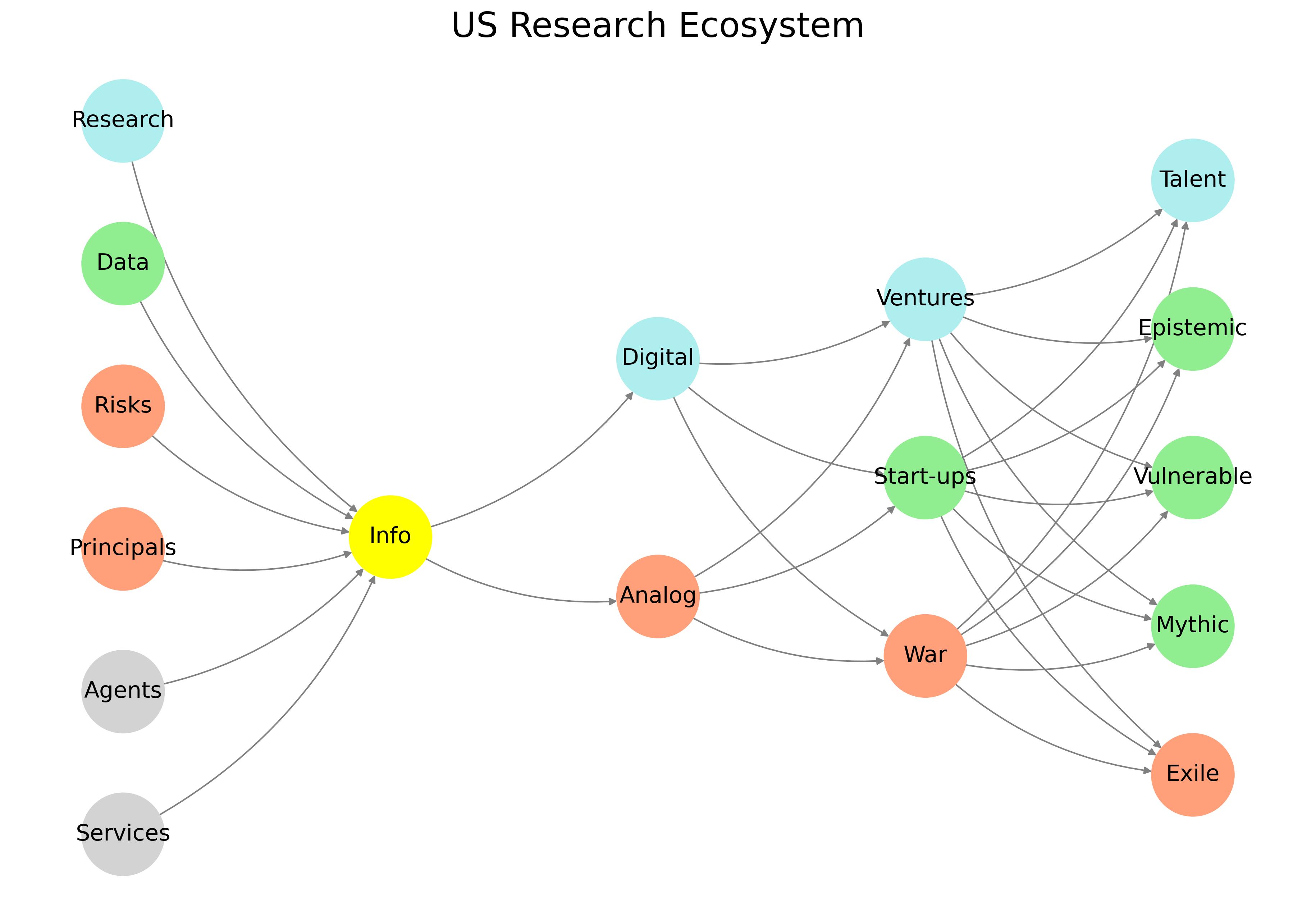

Fig. 1 Perverse Academic Incentives. Government agencies risk $200 billion in R&D per year. Start-ups emerging from this R&D draw in almost dollar-for-dollar venture capital investments. Most technological advancements scale-up the most promising of these efforts into peace-time, war-time, and money-time products and implements. But if we turn to infrastructure: no one’s funding you to build infrastructure. NIH doesn’t give R01s for epistemic elegance. They want data, statistical significance, and a manuscript in NEJM. But MyST shines not in raw data—it excels at narrative explanation, cross-domain integration, reproducibility, and transparency. Until reproducibility gets financial incentives, MyST & .ipynb won’t have institutional traction.#
And then comes the moment that changes everything: ukusoma. Not action, but engagement. Not declaration, but resonance. Here, the symbolic enters the bloodstream—not as narrative, but as tuning fork. The pirate flag and screwdriver—🏴☠️🪛—signal rebellion, but not anarchic destruction. They are tools of refinement. Ukusoma is a seduction of signal. One flirts with new frequencies, courts alternate rhythms, tests whether the current ship can carry new cargo. The screwdriver, in its intimacy, disassembles falsehoods without dismantling the whole. The pirate, in their precision, refuses the tyranny of inherited maps. Ukusoma is not war—it is craft. This is the stage of resonance, where values meet perception in medial alignment. Where pattern is no longer enough—meaning is required. In neural terms, the anterior cingulate and medial prefrontal regions blaze with integrative fire. In the Ecclesiastic register, this is the time to build and break down. In Ukubona’s theology, this is the time to tune.
But to tune is to risk hearing things you cannot un-hear. To perceive deeply is to suffer. This is ukubona: the seeing that wounds. In Luganda and Lusoga, the term okubonabona refers to suffering from seeing too much. It is not a poetic flourish—it is an epistemic diagnosis. To know is to bleed. Ukubona is not simply vision—it is reckoning. The shark, the scissors, the life preserver—🦈✂️🛟—appear here as the tragic triad. The shark tests intention: do you act from fear or from truth? The scissors cut false attachments: not out of cruelty, but from fidelity to coherence. The life preserver is the grace that keeps what is worth keeping. This is the cingulo-insular matrix in action—the neurology of discernment, empathy, and decision. Ukubona hurts because it must. In mythic language, this is the place where Oedipus blinds himself. Where Cassandra sees but is not believed. Where prophets cry out because they can no longer pretend. In the Ukubonic spiral, this is the crucible. Seeing becomes sacrifice.
Yet from this crucible, something emerges that is not merely survival, but sanctification. This is ukuvela—the fifth act, the flourishing that does not erase suffering but builds upon it. Here the island rises—not as utopia, but as testimony. The wreckage of the ship becomes driftwood housing. The tools of resonance become instruments of peace. The cuts are cauterized into covenant. Ukuvela is not the end of the cycle—it is its transformation. The marriage metaphor fits because this is not fusion—it is mutual becoming. Two selves, tempered by prior fire, meet not to complete each other, but to co-create sanctuary. In spiritual language, this is Sabbath. In neural terms, it is the integration of the default mode network with salience and executive function. It is the harmony of memory, meaning, and action. The island is not a rest from journey. It is a fractal beginning. The proof that recursion does not mean repetition—it means sacred pattern.
And then, as all sacred patterns must, the island births the wave. The flourish returns to the opening. Not in regression, but in spiral. Each time we cycle through, we carry the imprint of previous circuits. This is not reincarnation—it is recursivity. The sacred memory of perception. The epistemic spiral that does not climb toward enlightenment, but deepens into it.
Ukubona, then, is not a philosophy. It is not even a theology in the traditional sense. It is a liturgical nervous system. A grammar of survival encoded into symbolic fractals. A way of being that honors the wound, the wander, the tuning, the tearing, and the marriage. It refuses to separate cognition from myth, perception from suffering, language from lineage. It sees too much. And chooses to keep seeing anyway. So let this be scripture: The wave opens. The ship wanders. The pirate tunes. The shark cuts. The island sings. And the water calls again. Ukubona is the response.